CALL FOR PROPOSALS: 2026 APSA ANNUAL MEETING
Submissions are now open for the British Politics Group at the 2026 APSA Annual Meeting, Boston MA: September 3-6
Deadline: Wednesday, January 14, 2026, 11:59pm (Pacific Time)
The British Politics Group welcomes proposals for papers, panels, roundtables and other innovative formats on any topic related to British politics for the 2026 APSA Annual Meeting. We are open to proposals that focus on the United Kingdom as a case study as well as those that provide comparative perspectives on British politics, regardless of methodological approach.
Proposals may wish to consider the theme for the 2026 APSA Meeting, “Democracy under Threat: How to Understand, Protect, and Rebuild,” which invites participants to consider: “How do we understand the global crisis of democracy we face today? How do societies claw back democratic rights and practices when these come under assault? And how should we rebuild democratic institutions, norms, and practices?” In the context of the United Kingdom, proposals might consider challenges to democracy and/or efforts to promote and enhance democracy in a variety of domains, including but not limited to: political parties and populism, social movements and popular mobilization, law and civil liberties, or the politics of citizenship and identity.
In line with APSA’s diversity statement, we welcome submissions from scholars from diverse backgrounds, and we especially invite submissions from junior scholars or those new to the BPG. Note that all proposals must go through the APSA on-line process and must be submitted by the regular APSA deadline. Please follow APSA guidelines for submissions, e.g., paper proposals will need an abstract of the paper and full contact details for the presenter(s); panel proposals will need panelist names, paper titles, and abstracts. Please also note that all presenters including co-authors must be dues-paying members of the BPG in order to appear on the program (presenters may join the BPG after acceptance to the conference). Information about the British Politics Group, including membership information, may be found on this website via the “Membership” link. Additional questions may be addressed to the 2026 BPG Program Chair, Dr. Janet Laible, at jml6[at] lehigh.edu
For additional information about the 2026 APSA meeting, including the link for submitting proposals, please visit: https://connect.apsanet.org/apsa2026/
A Half-Century of British Politics:
Celebrating the 50th Anniversary of the British Politics Group
10 September 2025 — Vancouver, BC, Canada
A short course for the American Political Science Association Annual Meeting
PRELIMINARY PROGRAM
9:30 Welcome and Opening Comments – Terrence Casey, Rose-Hulman Institute of Technology
Morning Session: Paper Presentations
9:45-10:15
Ashlee Christoffersen, York University
In their Own Image: The UK Government and the Reimagining of Civil Society Equalities Organizations
10:15-10:45
Jonathan Arlow, University of Liverpool
Federal Lessons for Irish Unity: Comparative Insights from Belgium and Italy
10:45-11:00 BREAK
11:00-11:30
Karl Pike, Queen Mary, University of London
Fragmented Left and Right: Ideologies in 21st century British Politics
11:30-12:00
Tim Oliver, Loughborough University London
A Kingdom Misunderstood: European Elite Views of England and the UK
12:00-1:30pm LUNCH
Afternoon Session: Author Meets Critic Panel and Plenary Session
1:30-2:30 Politics at the Founding: Author meets critic panel on Terrence Casey’s Forging the Iron Lady: Margaret Thatcher, the 1970s, and the Origins of Neoliberalism
Terrence Casey, Rose-Hulman Institute of Technology
Alistair Howard, Temple University
2:30-2:45 BREAK
2:45-4:30 Plenary Session: Reflections on 50 Years of British Politics
Angelia Wilson, University of Manchester: Spot the difference? US and UK Populism
Kimberley Cowell-Meyers, American University: Northern Ireland and Irish Americans
Scott Greer, University of Michigan: The NHS and Health Policy
Alistair Howard, Temple University: Political Economy
Terrence Casey, Rose-Hulman Institute of Technology: The Changing Face of Conservatism
APSA ANNUAL MEETING 2025 IN VANCOUVER, BC, CANADA:
BRITISH POLITICS GROUP PANEL
Friday, 12 September 2025, 12:00pm to 1:30pm (PDT) – Location to be announced:
Continuity and Change in British Politics
Chair, Scott L. Greer, University of Michigan
Tim Oliver, Loughborough University: Perfidious Albion: Examining Contemporary Anti-Britishness and Anglophobia
Terrence Casey, Rose-Hulman Institute of Technology: Paths Back to Power: Lessons for Today from Tory Oppositions Past
CALL FOR PROPOSALS:
A HALF-CENTURY OF BRITISH POLITICS:
CELEBRATING THE 50TH ANNIVERSARY OF THE BRITISH POLITICS GROUP
SHORT COURSE FOR THE AMERICAN POLITICAL SCIENCE ASSOCIATION ANNUAL MEETING
10 SEPTEMBER 2025, VANCOUVER, BRITISH COLUMBIA
Submissions now being accepted!
To mark the 50th anniversary of the founding of the British Politics Group, we will be holding a one-day mini conference prior to the APSA conference in Vancouver.
The United Kingdom confronts perpetual crises – inflation, low growth, strains on public finances, challenges of immigration, and rising social unrest. Governments seem incapable of getting a handle on these problems, leading public discourse to become more extreme and trust and confidence in democratic institutions to erode. Ironically, this characterization of British politics may have been just as appropriate in 1975 as it is in 2025. Yet the UK has transformed vastly in the past fifty years, with radical re-imaginings of its dominant political ideologies, representative institutions, and social compacts with its citizens. Presenters in this short course will reflect on the transformation of the UK and its people, politics, and place in the world since the founding of the British Politics Group in 1975 and will consider what the next 50 years might hold.
As our mini conference considers British politics past and present, we are looking for a combination of reflective roundtables and traditional panels presenting new research. We would particularly appreciate established scholars who can invite younger scholars, including graduate students, to join them in participating.
Paper proposals can be submitted individually, although we will give preference to full panel submissions with a coherent them. Roundtable participants may with to focus on the broad trends in British politics since the BPG’s founding, or focus on a specific subject (e.g. “50 Years of Parliament”).
All submissions should include name, institutional affiliation, and e-mail contact (during the summer months). For roundtables, we only need the topic and participants’ names. For paper submissions, please provide an abstract of no more than three hundred words.
All submissions should be forwarded to Terrence Casey, Rose-Hulman Institute of Technology, casey1@rose-hulman.edu no later than 20 June 2025. Later submissions may be considered if possible.
Please note: APSA requires all short course participants to be registered for the main APSA conference and to pay a $25 fee per short course.
CALL FOR PROPOSALS: THE 2025 APSA ANNUAL MEETING
Submissions are now being accepted for the British Politics Group at the
2025 APSA Annual Meeting in Vancouver, British Columbia, Canada
The deadline for proposals is Wednesday, January 15, 2025 at 11.59pm (Pacific Standard Time)
The British Politics Group welcomes proposals for papers, panels, roundtables and other innovative formats on any topic related to British politics for the 2025 APSA Annual Meeting. We are open to proposals that focus on the United Kingdom as a case study as well as those that provide comparative perspectives on British politics, regardless of methodological approach. Proposals may wish to consider the theme for the 2025 APSA Meeting, “Reimagining Politics, Power, and Peoplehood in Crisis Times,” which invites participants to reflect upon the “. . . weakened political institutions, captured bureaucracies, fractured civil societies, and a ‘post-truth’ politics.”
In line with APSA’s diversity statement, we welcome submissions from scholars from diverse backgrounds, and we especially invite submissions from junior scholars or those new to the BPG. Note that all proposals must go through the APSA on-line process and must be submitted by the regular APSA deadline. Please follow APSA guidelines for submissions, e.g., paper proposals will need an abstract of the paper and full contact details for the presenter(s); panel proposals will need panelist names, paper titles, and abstracts. Please also note that all presenters including co-authors must be dues-paying members of the BPG in order to appear on the program (presenters may join the BPG after acceptance to the conference). Information about the British Politics Group, including membership information, may be found on this website via the “Membership” link. Additional questions may be addressed to the 2025 BPG Program Chair, Dr. Matt Beech, at m.beech[at]hull.ac.uk or to the BPG Executive Director, Dr. Janet Laible, at jml6[at]lehigh.edu
For additional information about the 2025 APSA meeting, including the link for submitting proposals, please visit: https://connect.apsanet.org/apsa2025/
NOW ACCEPTING PROPOSALS – DEADLINE MAY 1, 2024
BRITAIN IN CRISIS: PERILS AND PROSPECTS
A one-day short course before the APSA Annual Meeting in Philadelphia, PA, Sept. 4, 2024
The BPG looks forward to hosting a short course before the regular APSA meeting this year!
While Brexit has dominated discussion about the future of the United Kingdom and has – rightly or wrongly – been blamed for a range of policy challenges that the country currently faces, a focus solely on Brexit obscures the depth and range of crises confronting the British polity. For more than a decade, the United Kingdom has experienced political turbulence marked by systemic crises, including long-term shifts in the organization and conduct of party politics, the destabilizing of the social compact between citizens and the state, the stagnation of the economy and growing inequality, and increasingly fraught relationships among Britain, its European neighbors, and the global community. At the same time, British politics has been punctuated by shorter term crises, including COVID-19, that have increased the policy load on institutions, political actors, and citizens who are already struggling to respond to systemic issues and that highlight new fissures within the major political parties, which have strained to offer solutions or clear direction on how to move the country forward.
Why is the United Kingdom experiencing such profound structural and political crises now? Why do the major political parties seem unable to develop policy responses that can mobilize broad public support to solve problems? How have current crises reshaped long-standing policy debates in the UK around issues such as Scottish nationalism, conflict in Northern Ireland, and the rise of a multicultural society? How have crises had an impact on the ability of the UK to interact productively with its European neighbors and global partners, and how have UK foreign policy challenges themselves contributed to domestic political problems? Ultimately, is there a path forward to move the country beyond its present political, economic, and social crises, and from where in the political system is this impetus likely to emerge?
This full-day short course will grapple with these and related questions as the United Kingdom enters an election year with few clear answers to its multiple and interrelated challenges. We will examine “Britain in Crisis” from four perspectives: politics and the party system, foreign policy and the European Union, fiscal and economic policy, and public policy. These perspectives illustrate how the UK faces unprecedented challenges to the foundations and practices of its representative democracy, and presenters will explore both the substance of these challenges and possible solutions.
In addition to panelists invited by the British Politics Group, we welcome proposals from all APSA members whose work relates to the topics under consideration. Proposals for papers, panels, or other forms of participation should be sent to Dr. Janet Laible (Lehigh University), at jml6[at]lehigh.edu, no later than May 1, 2024. We especially encourage submissions by junior scholars, including graduate students. Further information about the British Politics Group can be found at http://www.britishpoliticsgroup.com (NOTE: accepted participants need not be members of the British Politics Group but are requested to become members. All participants must register for the full APSA conference in order to register for the short course. Short course registration involves a small fee that is collected by APSA).
APSA ANNUAL MEETING 2023 IN LOS ANGELES: BRITISH POLITICS GROUP PANEL
The British Politics Group is please to announce its panel at the 2023 APSA Annual Meeting in Los Angeles, with thanks to Dr. Chitralekha Basu for her work on organizing our program this year! We look forward to seeing many of our members in Los Angeles, from August 31 – September 3. Our panel, “British Politics and Public Opinion,” will take place on Saturday, September 2, from 12:00 to 1:30pm, location to be announced.
From Dr. Basu: “This British Politics Group sponsored panel brings together several papers on recent developments in British politics and political research. The papers examine topics including public opinion on politicians’ sociodemographic characteristics, views on Britain’s foreign policy, the preferences of council housing tenants, and party politics in Scotland and Wales.”
British Politics and Public Opinion
Chair: Angelia Wilson, University of Manchester
What Kind of Discipline Are We? A Network Analysis of British Politics Research (Christopher Byrne, Leeds Beckett University, and Nick Randall, Newcastle University)
English Views of the UK’s International Relations (Tim Oliver, Loughborough University)
How Important Are Candidate’s Sociodemographic Characteristics to Britons? (Matthew Hepplewhite, University of Oxford)
On the Role of Social Factors in Housing Preferences The Grenfell Tower Fire (Sophia Wang)
The Erosion (or Not) of Dominant Political Parties: Scotland and Wales Compared (Roger Awan-Scully, Hong Kong Baptist University, and Malcolm Harvey, University of Aberdeen)
CALL FOR PROPOSALS: THE 2023 APSA ANNUAL MEETING
Submissions are now being accepted for the British Politics Group at the
2023 APSA Annual Meeting in Los Angeles, California
The deadline for proposals is Wednesday, January 18, 2023 at 11.59pm (Pacific Standard Time)
The British Politics Group welcomes proposals for papers, panels, roundtables and other innovative formats on any topic related to British politics for the 2023 APSA annual meeting in Los Angeles, California. We are open to proposals that focus on the United Kingdom as a case study as well as those that provide comparative perspectives on British politics, regardless of methodological approach. Proposals may wish to consider the theme for the 2023 APSA Annual Meeting, “Rights and Responsibilities in an Age of Mis- and Disinformation,” which invites participants to reflect on the rights and responsibilities of both citizens and political scientists in an era where mis- and disinformation are prevalent. Proposals might address, for example, the prevalence of mis- and disinformation during the COVID-19 pandemic or the Brexit referendum, and implications for British politics. In line with APSA’s diversity statement, we welcome submissions from scholars from diverse backgrounds, and especially invite submissions from junior scholars or those new to the group. Note that all proposals must go through the APSA on-line process and must be submitted by the regular APSA deadline. Please follow APSA guidelines for submissions, e.g., paper proposals will need an abstract of the paper and full contact details for the presenter(s); panel proposals will need panelist names, paper titles, and abstracts. Please also note that all presenters including co-authors must be dues-paying members of the BPG in order to appear on the program (presenters may join the BPG after acceptance to the conference). Information about the British Politics Group, including membership information, may be found at britishpoliticsgroup.com. Additional questions may be addressed to the Program Chair, Chitralekha Basu, at basu[AT]wiso.uni-koeln.de or BPG Executive Director, Janet Laible, at jml6[AT]lehigh.edu.
APSA ANNUAL MEETING 2022 IN MONTREAL: BRITISH POLITICS GROUP PANEL
We look forward to seeing many of our members at the APSA Annual Meeting in Montréal from September 15-18, 2022. We thank our panel organizer, Chitralekha Basu, for her work on our program this year! Abstracts of each paper may be found on the APSA website on-line program.
The State of the Union(s): Sub-national Challenges to the UK
Thursday, September 15, 4:00pm – 5:30pm, location to be announced
This panel examines the pressures upon the maintenance of the UK. Amid continuing demands for a second referendum on Scottish independence, calls for a border poll on whether Northern Ireland should remain part of the UK or unify with Ireland and the growth of the Yes Cymru Welsh independence movement, the session examines the extent to which fears of the dissolution of the UK are real or exaggerated. Using new datasets from ongoing Economic and Social Research Council-funded projects, the panel assesses the degree of support for the Union with each of Scotland, Northern Ireland and Wales examining in particular a) the extent to which politics in each polity is defined by a unionist versus nationalist binary b) whether or not there is a discernible Brexit effect undermining fidelity to the UK and c) the impact of the rising institutional strength of the devolved governments and legislatures, exemplified by the variations in Covid regulations across the UK implemented by both pro- and anti-Union parties, in reconfiguring conceptions of Westminster’s relations with the nations of the Union. The panel assesses the modern purpose of the Union, explores whether current strains are likely to accentuate and considers what strategies of the containment of separatist tendencies are viable.
Chair: Jonathan Tonge, University of Liverpool
Discussant: Terrence Casey, Rose-Hulman Institute of Technology
Papers:
“Nationalism and Utopianism in Scotland and the United States,” Paul T. McCartney, Towson University
“Vote Switching and the Constitution: Evidence from the Scottish Election Study,” Ailsa Henderson, University of Edinburgh
“From Brexit to Border Poll? Northern Ireland’s Constitutional Future,” Jonathan Tonge, University of Liverpool; Thomas Hennessey, Canterbury Christ Church University; Maire Braniff, Ulster University; Jim McAuley, University of Huddersfield; and Sophie Whiting, University of Bath
“Wales and the UK: Territorial Strategies, Devolution, and Union,” Jonathan Paul Bradbury, University of Wales, Swansea
“Labour as the Party of Wales: Explaining 100 Years of Labour Dominance,” Richard Wyn Jones, Wales Governance Centre
ANNOUNCEMENT: THE DONALD E. STOKES DISSERTATION RESEARCH FELLOWSHIP
The British Politics Group is pleased to announce the Donald E. Stokes Dissertation Research Fellowship. This fellowship of $1000 U.S. is intended to assist a graduate student at a North American university working on a dissertation on British politics (broadly defined to include comparative and historical work as well as contemporary British politics) to conduct research in the United Kingdom. The application deadline for the 2022 competition is Saturday, April 30, 2022. Applications should include a prospectus of 3-5 pages (double-spaced) that outlines the project and makes clear how the fellowship will aid the research, plus a brief C.V. of no more than three pages. A letter from the Chair of the Dissertation Committee concerning the research is also required. Research should be conducted in the United Kingdom sometime during the period starting May 2022 through the end of December 2023. The successful applicant is required to submit a brief report (3-5 double-spaced pages) on the research financed by the fellowship no later than April 30, 2024. Applications will be judged by an international committee of British politics scholars.
The fellowship honors Donald E. Stokes, a founding member of the British Politics Group, a member of its first Executive Committee, and co-author of the seminal book, Political Change in Britain.
All materials and/or inquiries should be directed to:
Dr. Janet Laible, Executive Director
British Politics Group
Email: jml6[AT]lehigh.edu
Update on the BPG Virtual Conference on 8 December 2021
The agenda for our virtual conference, “Anglo-American Politics in Transition: After Brexit and Trump,” is now available here: BPG-CBP Conference_Final
The conference will be taking place on Zoom, beginning at 3pm in the UK – many thanks to our organizer, Dr. Kevin Hickson, for accommodating American participants with this schedule. The Zoom information is:
Topic: BPG Conference
Time: Dec 8, 2021 03:00 PM London
Join Zoom Meeting
https://liverpool-ac-uk.zoom.us/j/98209525998?pwd=RXZRRmtCam5TbmEwQUZKa0phSlNBUT09
(You may need to copy and paste this link). You will be admitted to the meeting by the host, so please wait if you find yourself in a ”waiting room.”
Meeting ID: 982 0952 5998
Announcing a one-day online conference via Zoom* on 8 December 2021:
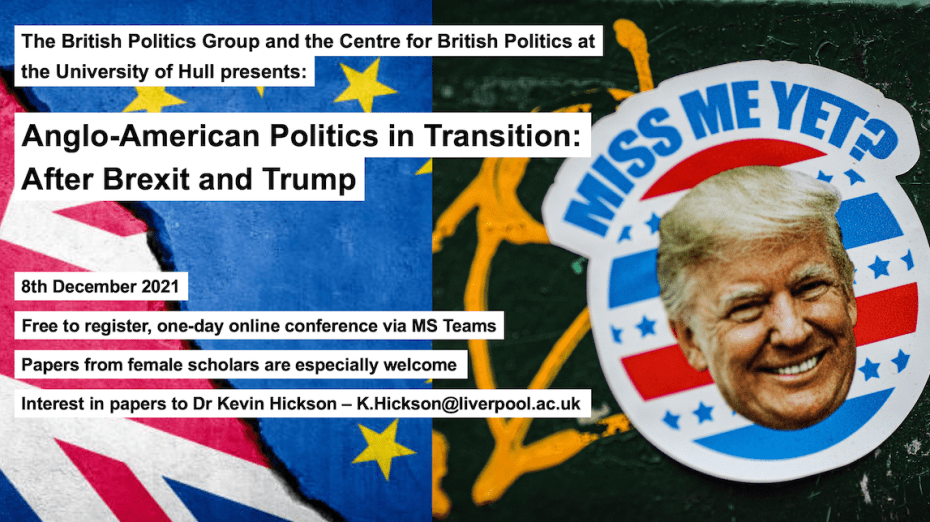
Anglo-American Politics in Transition: Beyond Brexit and Trump.
We are happy to announce that our previously-postponed short course will be going forward, with many thanks to Dr. Kevin Hickson of the University of Liverpool and in cooperation with the Centre for British Politics at the University of Hull. Proposals for papers are still being accepted. Please contact Dr. Hickson if you would like to propose a paper.
*Note that this conference will be taking place over Zoom, not MS Teams.
APSA Annual Meeting 2021: British Politics Group Virtual Panels
We are pleased to announce that the British Politics Group will have two panels at the upcoming APSA 2021 Meeting – many thanks to our program organizer this year, Holly Jarman, for assembling excellent panels. Both panels will be offered virtually (and thus you will need to access them through APSA’s on-line platform). Please be sure to check your time-zone, as both panels will be taking place at 6am local time in Seattle.
Britain Beyond Boris and Brexit: The Future Trajectory of Politics in the UK
Saturday, October 2, 6am to 7.30am (Pacific Daylight Time)
Come and join members of the APSA related British Politics Group for a roundtable discussion about the future of UK politics, particularly the big picture challenges that the Brexit debate has obscured. The UK is still redefining its role in the world and the terms of its own democracy, while tackling a global pandemic, facing an economic downturn, and struggling with ongoing issues of geographic and demographic political representation. With Brexit out of the way but not out of the picture, what will UK politics look like after a decade of disruption? Panelists will draw on their work on climate change, political economy, youth politics, public health, political parties and the welfare state to address this question.
Chair: Janet Laible, Lehigh University
Presenters:
Holly Jarman, University of Michigan
Sarah Pickard, Université Sorbonne Nouvelle – Paris 3
Mark Vail, Wake Forest University
Ian P. McManus, Emerson College
Representation, Welfare and the State in the United Kingdom
Sunday, October 3, 6am to 7.30am (Pacific Daylight Time)
Join the APSA related British Politics Group for a discussion of contemporary UK politics and democracy. What can we learn about the potentially volatile state of British politics by studying the UK’s governing elites, its democratic institutions and its health and welfare systems? Panelists will discuss their work on these topics as well as the challenges of conducting empirical research in contemporary Britain.
Chair: Janet Laible, Lehigh University
Discussant: Sarah Pickard, Université Sorbonne Nouvelle – Paris 3
Individual Presentations:
“G.I. Joe vs Tommy Atkins: Comparison of Veterans’ Benefits in the U.S. and U.K.,” Melissa Keller, University of Oregon
“Diagnosing the Health of British Democracy,” RIchard Rose, University of Strathclyde
“Tory Welfare in the Age of Brexit: From Cameron to Johnson,” Daniel Pitt, University of Hull
PLEASE NOTE: The short course has been cancelled due to current US restrictions on overseas visitors. We plan to offer this event in a virtual format at a later date – please check back for updates!
ANGLO-AMERICAN POLITICS IN TRANSITION: AFTER BREXIT AND TRUMP
This short course will be offered by the British Politics Group on Wednesday, September 29, 2021, in conjunction with the APSA Meeting in Seattle, Washington.
Recent years have seen unprecedented upheavals in both British and US politics. The 2016 referendum on continued membership of the European Union caused deep divisions in British politics, leading to two general elections, parliamentary gridlock and public demonstrations. Formal withdrawal was achieved in early 2020 and the trade deal announced on Christmas Eve, taking effect on 1st January 2021. Meanwhile in the USA the defeat of Donald Trump in November’s presidential election led to his calling the result into question and the storming of Congress.
Now, with both Brexit and the Presidential election resolved the aim of this one-day short course is to explain why these events happened and what the future holds. The ‘special relationship’ between the UK and the US may be challenged as never before. President Biden has professed his support for the European Union and disappointment at Britain’s withdrawal. Several leading advocates of Brexit had pinned their hopes on a trade deal with the US under the seemingly more sympathetic presidency of Mr Trump. The change of presidency may pose an obstacle to obtaining a trade deal going forward.
The future of US and UK politics is open to speculation in other ways. Some commentators on both sides of the Atlantic argued that the Trump presidency and Brexit were expressions of ‘populism’. Some hope that the apparent rejection of populism in the US with the election of Joe Biden will also spell the end of populism in Britain. However, for the moment at least, cultural conflicts remain deep in both countries.
Recent events also bring into new focus the role of both the US and the UK in geopolitics. There are numerous issues here but to name but two – what will relations between both countries and China be like going forward? There is a growing anti-China sentiment in the UK government. Some have argued that Biden will be more friendly towards China while others have questioned that. Will the UK and US reach a shared position on China and, if so, what will it look like? A second issue is the role of both countries in working towards common environmental goals. Trump was a skeptic on global warming but both Biden and Johnson have expressed a desire to bring about a new international agreement here.
Finally, both countries have been severely challenged by the global pandemic, being among the worst affected countries in the developed world. Will this lead to a new social and economic settlement in both countries?
The short course is organized by the British Politics Group and convened by Dr Kevin Hickson of the University of Liverpool, UK. Offers of papers and panels will be encouraged with the aim of having a full day event consisting of four full panels bringing together scholars from the US and the UK. Please send proposals to Dr. Hickson at K.Hickson[AT]liverpool.ac.uk
The BPG is pleased to announce our panel at the APSA 2020 (Virtual) Meeting*:
“Britain After Brexit”
Chair: Scott L. Greer, University of Michigan
Papers:
June Park and Troy Stangarone, Korea Economic Institute: “From Rules Makers to Rules Takers: The UK’s Choice on Huawei amid Brexit and AI”
Hannah Willis, University of Exeter: “Revisiting the Link Between Competitiveness and Turnout with Longitudinal Data”
Oleg Kodolov, University of Toronto: “The Obstacles to Brexit: Judiciary, Parliament, and the European Union”
Discussant: Nina Simeonova Barzachka, College of the Holy Cross
* Provisionally scheduled for Thursday, September 10, 2pm to 3:30pm (Pacific Daylight Time). We will update this information as we are able!
Brexit: Transforming Politics, Policy, and Institutions
28 August 2019
Co-sponsored by the British Politics Group and the Political Studies Association (UK), with support from the British Journal of Politics and International Relations
A one-day short course at the 2019 APSA Annual Meeting in Washington, D.C. at the Marriott Wardman Park, Room: Virginia C
PANEL 1 — REGIONS, IDENTITIES, AND THE CONTEXT OF BREXIT
9:15 – 10:15
Chair: Janet Laible, Lehigh University
“A Tale of Many Cities: London and the Future of Brexit Britain,” Tim Oliver, Loughborough University London
“Why March for the Nation? The Causes of Irish and British Identity-Activism in Northern Ireland, 2006-2016,” Adam Brodie, University of Oxford
BREAK 10:15 – 10:30
PANEL 2 — BREXIT AND POLITICAL ECONOMY
10:30 – 11:45
Chair: Andrew Russell, University of Liverpool
“EU Single Market(s) After Brexit,” Michelle Egan, American University
Paper is part of a special issue of Politics and Governance Vol. 7 No. 3 (2019) edited by Ferdi De Ville and Gabe Sils Brugge; all articles are open access and available to download. Egan’s paper is available here.
“International Trade Policy in a Post-Brexit World,” Holly Jarman, University of Michigan
“Brexit: Implications for Social Policy,” Scott L. Greer, University of Michigan
BREAK FOR LUNCH, 11:45 – 13:30
PANEL 3 — PARTY LEADERSHIP AND THE CHALLENGES OF BREXIT
13:30 – 14:30
Chair: Matt Beech, University of Hull
“Evaluating Theresa May as Prime Minister: Constraint and Choice in the Disjunctive Premiership,” Chris Byrne, Leeds Beckett University; Nick Randall, Newcastle University; and Kevin Theakston, University of Leeds
“Corbyn, Brexit, and State Aid: Prospects for a Revived British Industrial Policy,” Tom Wraight, Copenhagen Business School
BREAK 14:30 – 14:45
PANEL 4 — ROUNDTABLE: BREXIT – WHAT’S NEXT?
14:45 – 16:15
Chair: Terrence Casey, Rose-Hulman Institute of Technology
Participants:
Marc Geddes, University of Edinburgh
Henry Farrell, George Washington University
Matt Beech, University of Hull
Kevin Hickson, University of Liverpool
AS A GENTLE REMINDER: APSA short courses are intended only for APSA Annual Meeting attendees. You must register for the full APSA conference and the short course if you are presenting or attending. The short course fee – set by APSA – is $25. You will need to check in at the main APSA Conference Registration area in order to pick up your short course badge prior to attending. Based on past experience, APSA will be rather strict about enforcing these rules.
The BPG is pleased to announce our panel at the main APSA Conference!
Brexit and the Reordering of British Politics
Thursday, 29 August 2019, 10:00 – 11:30am, Hilton – Fairchild East
Co-sponsored with the European Politics and Society Division
Chair: Terrence Casey, Rose-Hulman Institute of Technology
Papers:
“‘Multiculturalism’ in Policy, Law and Theory: Britain, Brexit and Beyond,” Richard T. Ashcroft, University of California, Berkeley; Mark Bevir, University of California, Berkeley
“A Kingdom Divided: Brexit and the Reimagining of Labour’s Ideational Traditions,” Matt Beech, University of Hull
“Brexit and the Scottish National Tradition,” Stacey Spring, Boston University
“Brexit and the Conservative Tradition,” Kevin Hickson, University of Liverpool
Brexit and Beyond:
Implications for British and European Politics
Co-sponsored by the British Politics Group and the Political Studies Association, with support from the British Journal of Politics and International Relations
A one-day short course at the 2018 APSA Annual Meeting, Boston, MA; Wednesday, 29 August 2018 at the John B. Hynes Veterans Memorial Convention Center, Boston: Room 301
PANEL 1 — POLICY AND POLITICAL IMPLICATIONS OF BREXIT
CHAIR: TBD
0900-1015
“The Legal Consequences of Brexit,” Kelley Littlepage, University of Houston
“The Brexit Time Bomb: Are We Witnessing the Disintegration of the UK?” Peter Moloney, Boston College
“UK Policy-Making in a Post-Brexit World,” Richard Rose, University of Strathclyde
BREAK 1015-1030
PANEL 2 — IMPLICATIONS OF BREXIT FOR THE EU – I
CHAIR: Tim Bale, Queen Mary University, London
1030-1145
“Understanding Brexit: Process-Tracing, Critical Junctures and Institutional Reform,” Nina S. Barzachka, Dickinson College
“Getting out from Under those Judges? What Brexit Conflicts over the Court of Justice Reflects About British and EU Politics,” Lisa Conant, University of Denver
“A Renewed Project for Europe: Brexit and the Future of EU Enlargement Policy,” Jamie Scalera, Georgia Southern University
BREAK 1145-1200
PANEL 3 — BREXIT AND POLITICAL PARTY MEMBERSHIP
CHAIR: Terrence Casey, Rose-Hulman Institute of Technology
1200-1315
“‘The Secret of Leaving’: Who Quits Their Party and Why? Grassroots Members in the UK,” Tim Bale, Queen Mary University, London; Monica Polletti, Queen Mary University, London; and Paul Webb, University of Sussex
“From Multi-speed to multi-stream? Recognising the motivations, processes, and triggers in a multi-stream activation model of party membership,” Katharine Dommett, University of Sheffield; and Sam Power, University of Sheffield
“Brexit and the SNP: Threat or Opportunity?” Rob Johns, University of Essex; James Mitchell, University of Edinburgh; and Lynn Bennie, University of Aberdeen
“Determined and Distinctive Britishness: The Democratic Unionist Party’s Membership,” Jon Tonge, University of Liverpool; Sophie Whiting, University of Bath; Jim McAuley, University of Huddersfield; and Thomas Hennessey, Canterbury Christ Church University
LUNCH 1315-1445
PANEL 4 — IMPLICATIONS OF BREXIT FOR THE EU – II
CHAIR: Janet Laible, Lehigh University
1445-1600
“A Stronger European Union? The Unexpected Security Consequences of Brexit ,” Federiga Bindi, University of Rome Tor Vergata and SAIS Johns Hopkins University
“The Political Economy of Social Europe after Brexit,” Scott Greer, University of Michigan
“European Union Trade Policy in the Wake of the Brexit Vote,” Holly Jarman, University of Michigan
BREAK 1600-1615
PANEL 5 — THE NATIONS OF THE UK AND BREXIT
CHAIR: Nina S. Barzachka, Dickinson College
1615-1730
“Brexit’s Scottish Dimension: Dual Identities and Qualified Support for the EU,” Marco Biagi, Yale University
“Brexit and Historical Precedent: The Dangers of Underestimating the SNP,” Stacey Gorski Spring, Boston University
“United Kingdom and United Europe: The Implications of Brexit for Continued Unity,” A. Maurits van der Veen, College of William & Mary
AS A GENTLE REMINDER: APSA short courses are intended only for APSA Annual Meeting attendees. You must register for the full APSA conference and the short course if you are presenting or attending. The short course fee – set by APSA – is $25. You will need to check in at the main APSA Conference Registration in order to pick up your short course badge prior to attending. Based on past experience, APSA will be rather strict about enforcing these rules.
 The British Politics Group